Jul 31, Aug 7, Aug 28, Sep 4, Sep 25

Presuppositional
Apologetics
Bible Classes

A vindication of the Christian faith from Scripture — a beginner's introduction to the apologetic method that actually starts with God in our reasoning, understanding that no neutral ground exists.

5 Friday Evenings
July 31 — September 25
6:30–8:00 PM
Free · All Welcome
Why These Classes

What you'll walk away with

I.

A Biblical Foundation

See from Scripture itself why the method of vindicating the faith matters as much as the faith being vindicated. Learn how Scripture is uncompromising with the truth.

II.

Confidence in Conversation

Move past awkward debates and rehearsed talking points. Learn to ask the right questions, listen well, and trust the Holy Spirit's work as you speak.

III.

A Method You Can Use

Whether the person across from you is a skeptic, a relativist, a Muslim, or a culturally religious neighbor — one faithful method, drawn from Scripture, addresses them all.

The Five Classes

Five Fridays. Five conversations. One faithful Biblical method.

Each class is organized around an objection that you have likely already heard — perhaps from a coworker, a family member, or your own quiet doubts. We will answer them together, with Scripture leading the way and practical conversation skills built in. Click any class to read more.

I.

“Just Show Me the Evidence”

The unbeliever does not lack evidence—he lacks the framework to read it rightly, and already suppresses the God it reveals.
Friday, July 31
6:30 — 8:00 PM

We open the series with a brief, beginning-to-end overview of what a presuppositional conversation actually looks like — and then turn to Scripture to discover why this method is not one option among many but the Biblical pattern itself.

  • Acts 17, 1 Peter 3:15, Proverbs 1:7, Colossians 2, the Gospels... as foundations for the Biblical method
  • Romans 1:18–25 and the diagnosis of the unbeliever
  • 2 Corinthians 10:3–5 and taking every thought captive to Christ
  • No persuasion even when evidence is given (Luke 16:31, Acts 4:13-22, etc.)
  • Why the starting point determines the destination

The unbeliever's self-asserted autonomy yields presuppositions that suppress and reinterpret the facts so that no quantity of evidence, weighed on his terms, will compel the conclusion that the God of Scripture exists. The defect is in the interpreter, not the evidence. The demand “just show me the evidence” smuggles in the false assumption that the unbeliever is a competent neutral judge entitled to arbitrate the facts by his own self-asserted “autonomous” standard.
II.

“I Just Follow the Facts”

The myth of neutrality in practice
Friday, August 7
6:30 — 8:00 PM

The most common request a believer hears is “just be objective.” In this class we examine why that demand tries to pull Christians away from the objective truth God revealed, why Scripture forbids us from accepting that demand, and how to expose the demand Biblically.

  • What neutrality is and why no one actually possesses it
  • Why neutrality is sinful (Matthew 12:30, etc.)
  • The antithesis: two worldviews, two lords
  • Practical conversations and a guided role play
III.

“Prove God Exists”

The transcendental reversal
Friday, August 28
6:30 — 8:00 PM

When the unbeliever demands proof, we do not climb into his framework and try to argue our way up to a probable God. We reverse the question. This class introduces, in plain English, the transcendental argument and what drives it.

  • What “transcendental” means and why it matters
  • The impossibility of the contrary — in everyday terms
  • Internal critique followed by external presentation
  • The Holy Spirit's indispensable role in true persuasion
IV.

“Logic and Science Are Enough”

The borrowed capital argument
Friday, September 4
6:30 — 8:00 PM

The unbeliever lives in God's world and cannot escape it. He uses logic, expects science to work, and makes moral judgments — all of which require the Christian worldview to ground them. This class equips you with three questions that expose where the unbeliever is standing on borrowed ground.

  • Logic: universal, invariant, immaterial — and unaccountable on naturalism
  • Science: the uniformity of nature and the faithfulness of God
  • Ethics: real evil requires real holiness
  • Three questions non-Christians cannot rationally answer to support their worldview that you can take home and use
V.

“What About Other Religions?”

Pluralism, other worldviews & practical dialogue
Friday, September 25
6:30 — 8:00 PM

One method, many applications. In our final class we apply presuppositional thinking to Islam, Mormonism, relativism, and everyday pluralism — then turn the corner toward practical dialogue skills, role play, and sending you out as a faithful witness rather than just a clever debater.

  • Brief internal critiques of competing worldviews
  • Listening, asking, and staying focused on foundations
  • Addressing the whole person — mind and heart
  • Trusting the Spirit and remembering the goal: the gospel
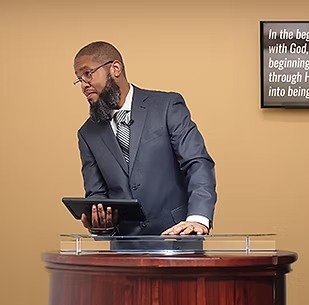
Pastor Jay
Your Teacher

Taught by Pastor Jay

Pastor Jay leads our congregation in expository preaching and is presently leading the church through a thorough verse-by-verse study of the Gospel of Mark. He holds to the doctrinal standards of the 1689 London Baptist Confession of Faith and appreciates the Reformed tradition's engagement with apologetics because it does not pretend that a neutral perspective toward God is possible.

These five classes flow from his pastoral desire to see every member of the body of Christ — not merely scholars or skilled debaters — equipped to demonstrate a thoughtful, Gospel-centered vindication of the hope they have in Christ. That kind of engagement does not set truth aside in order to reason toward a merely possible God, but begins with the God who is the foundation of every fact, thought, and argument.

Practical Information

The essentials

When & Where

Dates
Five Fridays
July 31 — September 25
Time
6:30 — 8:00 PM
Location
800 E. King St.
York, PA 17403
Cost
Free of charge
All are welcome
Level
Beginner
No prior study required
Bring
A Bible & a notebook
Reading suggestions provided each week

Common Questions

Do I need any background in philosophy or theology?+
Not at all. The classes are designed for those with no prior exposure to apologetics. Everything is taught from Scripture in plain English, with concrete examples and role-play practice built in.
What if I miss a class?+
Each class stands on its own enough that you can still benefit from attending later sessions. We recommend attending all five if at all possible, since the teaching builds class by class.
Is this for our church members only?+
No. All are welcome — members, visitors, friends, family, and anyone curious about how Christians can faithfully show the vindication of their faith. Please feel free to invite others.
Will there be reading or homework?+
No required homework. Optional readings from Greg Bahnsen, K. Scott Oliphint, and others will be suggested for those who want to go further between classes.
Do I need to register?+
Registration is not required, though a brief note to the church office via the contact section is appreciated so we can prepare adequately. Come and study with us — doors open at 6:15 PM.

Come ready to think, to listen, and to be equipped.

No experience necessary. Just bring a Bible, something to take notes with if you like, a willingness to learn, and a joy for our great Triune God!

See the Five Classes

Optional

Planning to Attend?

Registration isn’t required, but letting us know you’re coming helps us prepare. Fields marked * are required.

Classes you plan to attend *
Age range
How did you hear about the classes?